A British Delegation to Beijing 234 years before Keir Starmer
When Keir Starmer landed in Beijing last Wednesday, we had the honor of giving part of his following a crash course in the history of old Beijing. Starmer followed in the footsteps of many British diplomatic missions to China before his own. Probably the most famous one took place in 1793 and was led by the Scottish Lord Macartney.
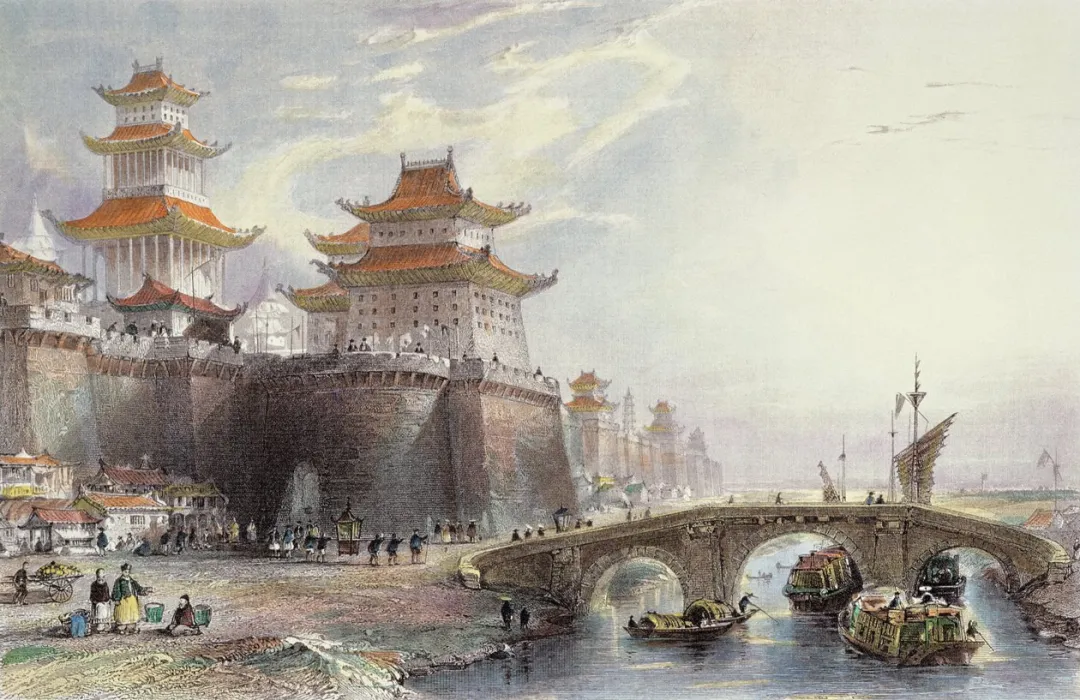
The European idea of Beijing was, for a long time, more imagination than reality
It is interesting to compare the Macartney and Starmer missions, 234 years apart, so different in nature but with many overlapping diplomatic goals in common.
In Macartney’s entourage was a translator named John Barrow. In his journal, he described the entry to Beijing, “In front marched about three thousand porters, carrying six hundred packages; some of which were so large and heavy as to require thirty-two bearers.”
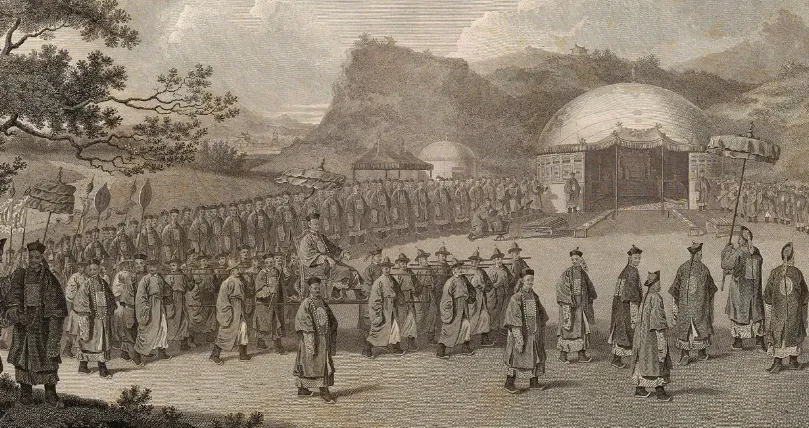
The Qianlong emperor preparing to meet with George Macartney and his mission, as depicted in an engraving by William Alexander in An Authentic Account of an Embassy from the King of Great Britain to the Emperor of China (1797).
In the packages Barrow described were a hot air balloon, a rifle made of pure gold, a planetarium, several clockworks, and much, much more. Every item had been carefully selected in order to support the prestige of the British delegation and create an interest in Western products.
In this light, the special edition labubu, which was gifted to Starmer in China when he visited the Chinese company Popmart in Shanghai, seems very inferior. The truth is that the immediate importance of gift exchange is not what it was. Before Macartney arrived, a list of the gifts the mission had prepared for the emperor had been sent many months in advance to the Imperial court, and the items prepared introduced whole new knowledge in the Middle Kingdom. That was not the case for the Starmer mission. Today it is difficult to surprise the Chinese with anything.

While Lord Macartney sought to introduce British products in China. Keir Starmer's visit paved the way for Labubu dolls entering the U.K.
Before arriving inside the walls of Beijing, Macartney's mission had scant knowledge of the Chinese capital.
When the gates of the capital opened, Barrow made sure to write down everything that met his eyes. He saw an enormous city built in one storey. He noticed that, despite it being one of the largest cities in the world, it had no sewers, and he found the smell repulsive. He was also mesmerized by the constant hustle and bustle in the streets and noticed that Han-Chinese women were rarely seen outside.
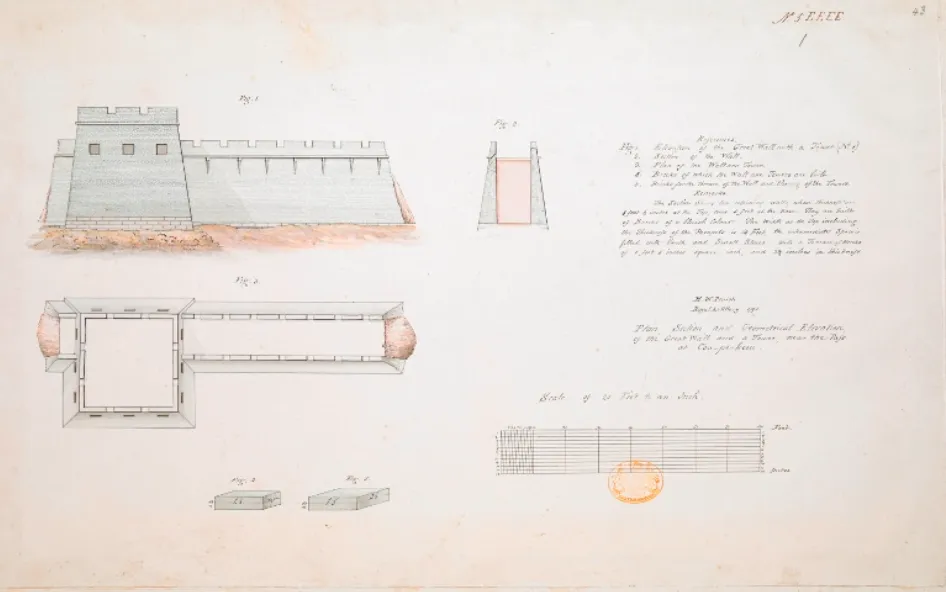
Some of the first technical drawings of the Great Wall made by a member of the Macartney mission
The Starmer mission, on the contrary, had an avalanche of information about China at their disposal before their arrival, but so little time to process it. Where Macartney’s trip took around 2 years to complete, Starmer was in China for 5 days in China before he flew home.
One of the initial successes of Starmer’s visit was a 3-hour-long talk with Xi Jinping, and for Macartney, it was also a big concern how he could get the ear of the Chinese emperor Qianlong. When the first audience finally took place, Qianlong decided that Macartney should meet him in his palace in Chengde (Gehol), more than 100 kilometers away from the capital.
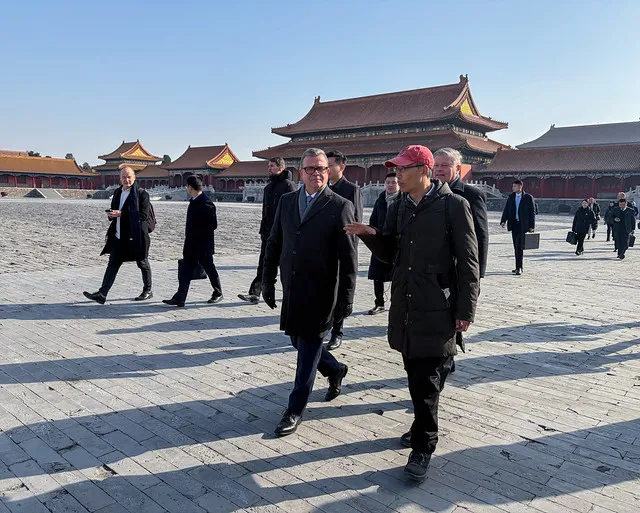
Last week Keir Starmer was not the only Prime Minister to visit Beijing, the Finish P.M Petteri Orpo visited the capital, and Beijing Postcards' own Wang Xiaoxin had the honour of showing Orpo around the Forbidden City. The two would follow in the footsteps of the Prime Minister's countryman, Osvald Siren, author of the book “Walls and Gates of Peking”. While John Barrow of the Macartney mission was not impressed by Beijing, Osvald Siren saw the city as an urban masterpiece. In 1922, Osvald Siren was invited into the palace and shown around by the last emperor, Puyi himself. Only two years after this, a warlord ousted the emperor from the palace, and Beijing changed forever.
The translator, John Barrow, stayed behind in the capital to look after the gift items. Barrow describes how Young Chinese princes, eunuchs, and other dignitaries would, out of curiosity, hang around the quarters where he was unpacking the presents and making them ready for Imperial inspection. However, suddenly the visits stopped, and John Barrow detected a change of mood from the Chinese side. Barrow asked an old eunuch what the matter was: “His answer was, We are all lost, ruined, and undone! He then informed me that intelligence had arrived from Gehol, stating, that Lord Macartney had refused to comply with the ceremony of prostrating himself, like the Embassadors of tributary princes, nine times before the Emperor,.., the great officers of state in the tribunal or department of ceremonies in Pekin were mortified, and perplexed, and alarmed; …, in short, it was impossible to say what might be the consequence of an event unprecedented in the annals of the empire. ”
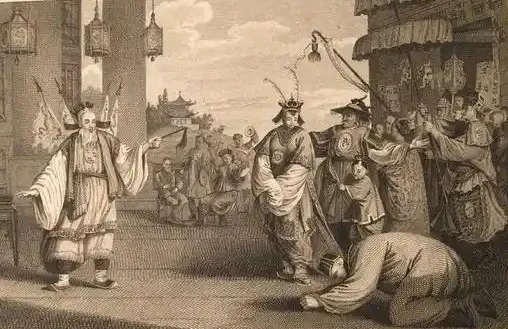
It is discussed to this day whether Lord Macartney’s refusal to prostrate himself (kowtow) in front of the emperor meant that his mission ultimately failed, but no matter what importance is put on the prostration, historians generally agree that the mission did fail. Rather than easing tensions between China and Britain, the mission had caused them to grow.
The Macartney delegation’s access to Beijing was very exclusive. Most western delegations were at this time confined to Guangzhou, more than a thousand kilometers away, and only allowed to stay there on a seasonal basis. It is therefore interesting that Keir Starmer’s mission ensured visa-free access to China for British citizens, something that was unimaginable not only during the Qing dynasty, but also, quite frankly till a few years ago.
In this way, Starmer’s wish of thawing a diplomatic ice-age seems well underway, but the real impact of his visit only time can tell.